Nigerian Army begins 77 regular recruitment 2018


The Nigerian Army says it has commenced its online registration for the 77 Regular Recruit Intake for both trades, non-tradesmen and women from December 29 to February 9, 2018.
The army spokesman, Sani Usman, a brigadier general, said in a statement on Saturday that the exercise was aimed at selecting able bodied Nigerians and would take place in all states.
“Interested applicants must be Nigerians between the ages of 18 to 22 for non-tradesmen and women, while tradesmen and women must be between 22 to 26 years by 1st March 2018.
Application commences on 29 December 2017 and ends on 9 February 2018.

Register with a valid email address
Complete the Online Application Form
Print and attest documents generated - Application and Guarantor forms
Visit designated examination and recruitment centres with above documents

Applicant Eligibility
Applicants shall be of Nigerian origin by birth and possess National Identity card.
Applicants must possess a minimum of 4 credits in not more than 2 sittings in WASSCE/GCE/NECO/NABTEB. One
of the credits must be in English language.
In addition, Tradesmen & Women Applicants must also possess OND/Trade Test/City and Guild certificate
Non-Tradesmen & Women Applicants must be aged between 18 - 22 years by March 1, 2018.

Tradesmen & Women Applicants must be aged between 18 - 26 years by March 1, 2018.


Applicants must be medically, physically, and psychologically fit and must not be less than 1.68 meters tall for male and 1.62 meters tall for female.
Applicants must print their completed online forms, attest it and submit it at the examination recruitment centres during the screening exercise period.

Knowledge of additional Nigerian Languages other than mother tongue is an added advantage

Requirements for entry as Non-Tradesmen or Non-Tradeswomen

ReferenceCategoryQualification
A1Non Tradesmen/WomenPossess a minimum of 4 credits in not more than 2 sittings in WASSCE/GCE/NECO/NABTEB. One of the credits must be in English.


Requirements for entry as Tradesmen or Tradeswomen

SerialCorpsTradesmen RequiredEducational QualificationTrades Qualification
1Nigerian Army Engineers
  1. Masons/Bricklayers.
  2. Carpenters.
  3. Plumbers.
  4. Electricians.
  5. Plant Operators.
  6. Refrigeration and Air Condition technicians.
  7. Tillers.
  8. Welders/Metal Works.
  9. Painters.
  10. Iron Benders.
  11. Aluminium Work.
Possess a minimum of 4 credits in not more than 2 sittings in WASSCE/GCE/NECO/NABTEB. One of the credits must be in English.
  1. Government Trade Test 1.
  2. Apprenticeship Certificate.
  3. OND or certificate from approved Institutions.
2Nigerian Army Signals
  1. Electronic installations and maintenance.
  2. Radio TV and electronic works.
  3. Computer Operation and maintenance.
  4. Workshop practices.
  5. ICT competence in various fields.
  6. Data communication and network technician.
  7. Competence in VSAT installations, networking and infrastructural design.
  8. Knowledge in Urban Communication System (UCS) deployment, employment and networking.
  9. Surveillance technology.
  10. Fibre Optics Technology.
  11. Electrical technician.
  12. Computer technician.
  13. Proficiencies in French Language.
  14. Skills in CCTV installations and networking.
Possess a minimum of 4 credits in not more than 2 sittings in WASSCE/GCE/NECO/NABTEB. One of the credits must be in English.OND Physics, technical field or French, Pre ND, NCE technical or french, Certificates of Remedial studies (Physics, electrical electronics). Vocational trade proficiency certificate for artisan.
3Nigerian Army Corps of Supply and Transport
  1. Caterers.
  2. Drivers.
  3. Boat Operators.
  4. Boat Engineers.
Possess a minimum of 4 credits in not more than 2 sittings in WASSCE/GCE/NECO/NABTEB. One of the credits must be in English.
  1. Government Trade Test 1.
  2. Apprenticeship Certificate.
  3. OND or certificate from approved Institutions.
  4. Basic catering course.
  5. Valid drivers licence with 3 years experience.
  6. Basic Boat Operators/Engineering.
  7. OND or certificate from approved Institutions.
4Nigerian Army Medical Corps
  1. Nursing.
  2. Drivers.
  3. X-Ray technicians.
  4. Dental technician
  5. Pharmacy technician.
  6. Environmental technician.
  7. Biomed technician.
  8. Medical supply.
  9. Pysiotherapy.
Possess a minimum of 4 credits in not more than 2 sittings in WASSCE/GCE/NECO/NABTEB. One of the credits must be in English.OND/RN/RM or certificate from approved Institutions.
5Nigerian Army Electrical and Mechanical Engineering
  1. Fabrication/panel beater.
  2. Vehicle mechanic.
  3. Radio/Electronic technician.
  4. Instrument Technician.
  5. Mechanical/Electronic Engineering.
  6. Refrigeration & Air-Conditioner technician.
  7. Upholsterers.
  8. Spray painting.
  9. Vulcanizing.
  10. Electro-medical technician.
  11. Boat technician.
  12. Carpentry/Woodwork.
  13. Sign Writers.
  14. Blacksmiths.
  15. Generator/Plant technicians.
  16. Automotive Electricians.
  17. Welders.
  18. Automtive Electricians
Possess a minimum of 4 credits in not more than 2 sittings in WASSCE/GCE/NECO/NABTEB. One of the credits must be in English.
  1. NABTEB tech Certificate.
  2. Trade Test Certificate.
  3. City & Guilds.
  4. Graduate of technical College.
  5. OND or certificate from approved Institutions
6Directorate of Army Physical Training
  1. Sportsmen/women.
  2. Sports instructors.
Possess a minimum of 4 credits in not more than 2 sittings in WASSCE/GCE/NECO/NABTEB. One of the credits must be in English.
  1. NABTEB tech Certificate.
  2. Trade Test Certificate.
  3. City & Guilds.
  4. Graduate of technical College.
  5. Champions in national/international sports competition.
  6. OND or certificate from approved Institutions
7Nigerian Army Intelligence Corps
  1. Computer Operators/technicians.
  2. Language Experts.
  3. Interpreters.
  4. Drivers.
  5. Electricians.
  6. Plumbers.
Possess a minimum of 4 credits in not more than 2 sittings in WASSCE/GCE/NECO/NABTEB. One of the credits must be in English.
  1. NABTEB tech Certificate.
  2. Trade Test Certificate.
  3. City & Guilds.
  4. Graduate of technical College.
  5. OND or certificate from approved Institutions
8Nigerian Army Education Corps
  1. Language teachers.
  2. Educationists.
  3. Library scientists.
Possess a minimum of 4 credits in not more than 2 sittings in WASSCE/GCE/NECO/NABTEB. One of the credits must be in English.
  1. NCE
  2. knowledge in languages like French, Arabic, Portuguese, Spanish and German.
  3. Library science qualifications.
  4. Teacher training certificate
  5. OND or certificate from approved Institutions
9Nigerian Army Ordnance Corps
  1. Tailors
  2. Storemen/Women
  3. Printers
  4. Book-keepers
Possess a minimum of 4 credits in not more than 2 sittings in WASSCE/GCE/NECO/NABTEB. One of the credits must be in English.
  1. NABTEB tech Certificate.
  2. Trade Test Certificate.
  3. City & Guilds.
  4. Graduate of technical College.
  5. OND or certificate from approved Institutions
10Nigerian Army Band Corps
  1. Singers.
  2. Song Writers
  3. Instrumentalists
Possess a minimum of 4 credits in not more than 2 sittings in WASSCE/GCE/NECO/NABTEB. One of the credits must be in English and Music.
  1. NABTEB tech Certificate.
  2. Trade Test Certificate.
  3. City & Guilds.
  4. Graduate of technical College.
  5. OND or certificate from approved Institutions
11Directorate of Army Public Relations
  1. Journalists.
  2. Photographer.
  3. Video Cameramen/women
  4. Video Technician
  5. Graphic Designers
  6. Public Address Operator/Audiography
Possess a minimum of 4 credits in not more than 2 sittings in WASSCE/GCE/NECO/NABTEB. One of the credits must be in English.
  1. NABTEB tech Certificate.
  2. Trade Test Certificate.
  3. Photography
  4. Video Camera Technician
  5. Graphic Design
  6. Public Address Operator/Audiography
  7. OND Journalism or certificate from approved institutions
  8. OND or certificate from approved Institutions
12Army Aviation
  1. Mechanical Technicians
  2. Electrical Technicians
Possess a minimum of 4 credits in not more than 2 sittings in WASSCE/GCE/NECO/NABTEB. One of the credits must be in English and Music.
  1. Mechanical Technicians - ND in Mechanical Engineering.
  2. Electrical Technicians - ND in Electrical Electronics, ND/Test Certificate in Domestic Electronics.
13Chaplaincy (Islamic)Possess a minimum of 4 credits in not more than 2 sittings in WASSCE/GCE/NECO/NABTEB. One of the credits must be in English and Music.
  1. An Islamic Clergy.
14Chaplaincy (Roman Catholic)Possess a minimum of 4 credits in not more than 2 sittings in WASSCE/GCE/NECO/NABTEB. One of the credits must be in English and Music.
  1. An Ordained Roman Catholic Priest.
15Chaplaincy (Protestant)Possess a minimum of 4 credits in not more than 2 sittings in WASSCE/GCE/NECO/NABTEB. One of the credits must be in English and Music.
  1. A Christian of Protestant denomination.
  2. Diploma or certificate in Theology.
  3. Certificate or NCE in Christian Education.
  4. SSCE/GCE or NECO with credit in English Language and CRK.
16Finance CorpsPossess a minimum of 4 credits in not more than 2 sittings in WASSCE/GCE/NECO/NABTEB. One of the credits must be in English and Music.
17Military PolicePossess a minimum of 4 credits in not more than 2 sittings in WASSCE/GCE/NECO/NABTEB. One of the credits must be in English and Music.
APPLY NOW

RECRUITMENT INTO KADUNA STATE ROADS AGENCY (KADRA) 2018


The Kaduna Roads Agency is seeking to employ individuals of significant credibility,competence to contribute the development of the state through the activity of its Kaduna Roads Agency.


Nestle Nutrition Postgraduate Fellowship Program for Young Professionals in Developing Countries 2018 – ( 40,000CHF in Grants)


The Nestle Nutrition Institute Fellowship Program is offering Young professionals in healthcare the opportunity to study Nutrition and Maternal and/or Child Health in leading institutions.
Application Deadline: 1st March 2018. Offered annually? Yes

Eligible Countries: Developing countries
Eligible Field of Study: Maternal and/or Child Health, Nutrition and any related field(s)
About the Award: The Fellowship offered by Nestle Nutrition Institute regularly offers young professionals from developing countries training in research skills and knowledge on Nutrition. Since 1981, more than five hundred (5oo) doctors and scientists have benefited from this fellowship and clinical grants in different ways, which have directly impacted the health sectors of Africa and other regions.
Offered Since: 1981
Type: Postgraduate
Eligibility: 
  • Potential candidates should submit an application describing their interest in participating in the NNI Research training Fellowship.
  • Priority consideration for this prestigious fellowship will be given to candidates in junior positions from emerging countries.
  • The candidates’ history of previous or alternate grants will be taken into consideration.
  • Candidates will be notified of their eligibility by letter.
  • The application form must be accompanied by the following:
    1. Curriculum Vitae,
    2. A plan of the proposed training/activity clearly indicating its specific outcomes and
    3. Two letters of recommendation (1 from the institution where the candidate is working and 1 from the host institution*).
    4. Letter stating intent to return to the home country upon completion of the training program
    5. Details of their current level of training
Selection Criteria:
  • Fellowships are available for post graduate qualifications only
  • Applicant has to be affiliated with an academic/clinical institution
  • Successful candidates will be required to start their training within 1 year of being notified of the fellowship award
  • Duration of the support for the research training lasts for a maximum of 12 months
  • Upon certification, fellowship awardees must return to their home countries.
The Panel will not accept applications, which are submitted by:
  • Candidates who have already spent more than 12 months outside their home country during the 3 years preceding the application. Exceptions could be made if the applicant can justify how this additional training will supplement the one(s) already obtained
  • Candidates who have already left their country at the time of applying for the fellowship
  • Candidates who have completed more than one half of any training programme they may already be enrolled in
  • Candidates who, at the time of submitting their application, already have a grant from any other training program
  • Applications will not be entertained if the applicant’s home country law prohibits the nature of this activity.
Number of Awardees: Not specified
Value of Scholarship:  The grant includes learning a specific laboratory technique, statistics, nutrition, etc. The NNI grant up to 40’000 CHF can be used to pay course registration fees, round trip travel to the host institution, lodging and living expenses and health insurance coverage for the duration of the course.The grant offer of 40’000 CHF is also given and can be used to pay course registration fees, round trip travel to the host institution, lodging and living expenses and health insurance coverage for the duration of the course.
Duration of Scholarship: Maximum of twelve (12) months
How to Apply: 

  • Applications should be sent by email to NNI@nestle.com or by fax to + 41 21 924 2836.
  • Applicants should plan to start their program not sooner than 3 months after the application deadline to give time for approval process and administrative arrangements with a host institution.
  • Applicants are urged to submit only one application and for a single programme. If you have more than one project, decide which is your best option and submit that one.
  • Applications without all documentation, including a letter of acceptance by the faculty at the hosting institution will not be considered.
Award Provider: Nestle Nutrition Institute
Important Notes: The NNI grant will be given to the Host Institution which will disburse it to the fellow. In no case will any money be given directly from the NNI to the fellow.
Before any money can be allocated to the research training fellowship, applicants will need to produce proof of health insurance for the country they will be visiting for the whole duration of stay.

What CTE Gets, What CTE Needs To Get More


Most of us (educators, business leaders, researchers, students and parents) have realized by now that our educational system has been and continues to be desperately behind in terms of success, especially as it connects to the future of work and our economy. If you don’t agree, stop reading and go watch one of those “Housewives of $%&^#*” shows.
With the continued demand need for change, we have turned to many solutions - including, but not limited to new standards, assessments, technology and programs. Historically, we had two high school tracks. There was vocational education - programs designed to train people for blue collar jobs. And then, in contrast, there were those that did a college prep program where the goals were college and a white collar job. Ironically, many of our college grads and non-grads now find themselves in grey collar jobs (underemployed and working in a career that did not require a college degree or their level of education). But I truly digress.
What I’m suggesting now is that we cannot look at education in terms of finite or separate categories. All students need high level learning, while also seeing connections between their education and long-term career/life paths. That is why most educators, and others who are trying to lead the way, are continually looking at things that include different pedagogies (project-based learning, design thinking, tech integration) and newer programs (Career Technical Education, STEM, Makerspaces, Linked Learning).
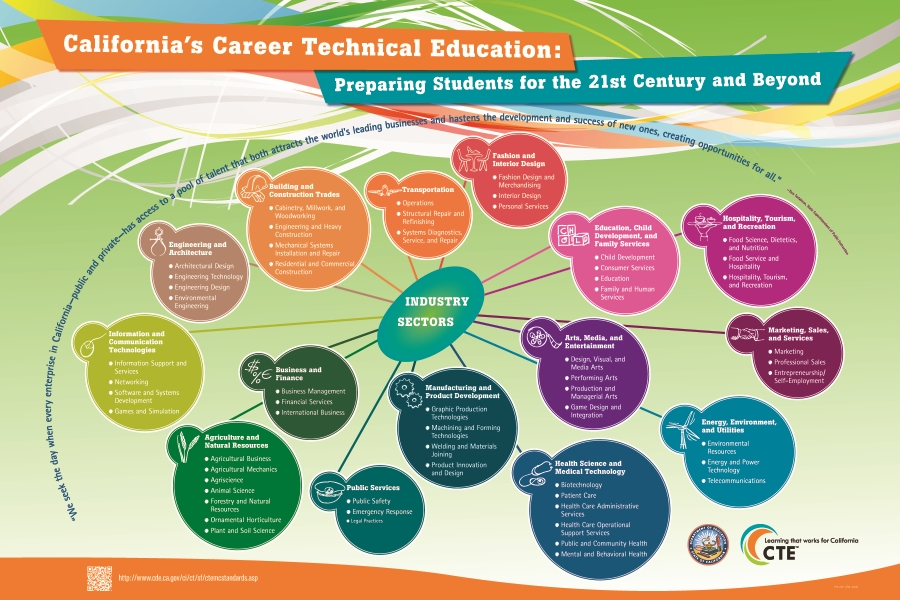
I’d like to focus on one of these programs or approaches that has been getting alot of attention and rightfully so. Vocational Education has re-emerged and is now called Career Technical Education (often referred to as CTE). CTE is now visible in almost all secondary programs through specific career pathways, academies, linked learning programs, electives classes and more. Whereas the former vocational education was hands-on, it was not necessarily steeped in the new CTE elements of career pathways, industry standards, professional advisory groups, internships and other work-based learning. CTE is now standards-driven and working to respond to our new global economy, as well as means of connecting students to their learning. CTE works to engage students, create meaningful ways to build skills and learn content, as well as to have students be thinking about their long-term career path and educational needs. Indeed, students in these CTE courses have higher high school graduation rates, college success rates, grade point averages and career placement.
CTE’s foundations and intentions are both good. It is grounded in connections to the real world and career. However, in my estimation, based on many visits to high schools and colleges around the country, there are some things that CTE needs to incorporate in terms of pedagogy and culture that are more aligned with the rest of the change in education.
Non-CTE programs could learn a great deal from the world of Career Technical Education. They could pay closer attention and adopt/adapt the following practices into programs affecting all students. Let’s first look at what CTE does well and then what CTE can improve upon:

WHAT CTE GETS

  • Student Choice - by now, we must realize the amazing human impact of choice. CTE programs and courses are typically ones that students opt into, not just land in like our core programs. They represent areas of interest and careers and therefore have built-in student buy-in and relevance. I have argued for a long time that our core programs need to design aspects of choice throughout. Choice could be represented in course selections or ways to meet requirements, which projects to pursue, which collaborators to engage, how to present your final work and more. Even within CTE programs, there is often choice to pursue various certifications, experiences, internships and more. The more options, the likely the ultimate buy-in and engagement.

  • The Power of the Cohort - many CTE programs have students cohorted where they experience anything from multiple courses, teams of teachers and even projects together. The idea of a cohort is to gather strength and trajectory from the consistent and focused community that becomes more comfortable with another, as well as more successful over time. They become tight knit machines who have positive and professional relationships with one another, their teachers/advisers, community partners and mentors.

  • Skills-Focused - In our core academic areas, or our dominant current paradigm, there has been a move to be more skills-focused. The new standards and assessments have made a concerted effort to realign with skills and performance. That being said, everything from our graduate profiles to core curriculum still leave much to be desired when it comes to identifying and mastering skills. Yet, the private sector and industry, which CTE looks to for direction, is more focused on skills than ever before. Those are both technical skills and soft skills. The reality is that CTE courses and programs do a better job for students in both areas. The technical skills are applied, practiced and even perfected at times in real world, industry-related situations. And because there are typically more collaborations (peer-to-peer, mentoring, work-based learning, industry partners), soft skills are valued, taught, assessed and practiced a great deal more.
  • Partnerships - Due to the CTE expectation of having to partner with industry advisory boards, programs have built-in advisers, partners and mentors. These industry partners can serve as not only advisers, but also contest judges, presentation audience members, work-based learning opportunities and so much more. They can also contribute to and support curriculum development, equipment and resources, industry trends and developments, community engagement, administrative support, program advocacy, showcase/exhibition venues and much more. It is imperative that students have adult relationships, mentors if you will, outside of the school and home environment. These should be professionals from industry, business, government or non-profit work that serve the students, their future employees and customers, as an educational support system.


WHAT CTE NEEDS TO GET MORE

  • Instructional Pedagogy - this seems to be a common weakness in CTE classes and programs. Although there are great tools, resources, hands-on opportunities, industry partnerships and more, there is often not an understanding of more contemporary and 21st century-oriented instructional approaches and pedagogies. Many of our CTE instructors come from industry and have very little formal teaching experience or training. This is not automatically bad, but they need to realize much has changed and evolved instructionally since their days in school. For example, many CTE instructors still rely on direct instruction exclusively (lecturing) then disseminating new content or information to their students. They would benefit from more collaborative and student-led practices that are more engaging. Additionally, they would also benefit from learning approaches such as project-based learning. Although, they have lots of hands-on activities and labs, they need to connect the hands-on to larger instructional and learning needs and challenges. Their industry associations and equipment are often new school, but far too often their teaching practices are old school.

  • Tech Integration - There is some irony here as there is with the pedagogy. For example, most CTE programs are fairly adept at incorporating their latest tech from their industry. Many of them are using everything from 3-D technology to drones to industry-specific software. But there they often lack is in the area of instructional technology. Many instructors are still lecturing and having students take notes, versus having students collaborate digitally on tasks and challenges. Many are not using things such as Google Applications, web-based resources, various video and presentation applications. While some of their core colleagues, albeit a minority, are doing things like having students blog or create their own websites/digital portfolios, too many CTE instructors are still having students keep paper notebooks, binders, worksheets and textbooks. They need to get core teachers to use the industry tech, while they use a lot more of the instructional tech that the core teachers are using.

  • Public Work - This is directly connected for the most part to the first two. Many of our CTE programs have students producing high quality work. But far too often, no one knows about it. Our students are entering an economy where their personal branding, marketing and presentation skills are going to be more vital than ever before. They are going to compete regularly for “gigs” also known as employment. It’s tragic to know some of the fine work that students have completed and even mastered, but yet are not featuring on a website, blog or digital portfolio. It’s a sin to not have demos and presentations of their work on YouTube and Vimeo. It’s limiting them if their work is not part of public spaces, meetings, showcases and exhibitions.

  • Future of Work & the Gig Economy - We often think that any change that is happening now has happened before. Yes, we have experienced technological advances before. Yes, we have had radical new economies emerge before. Yes, we have witness global changes previously. However, many experts agree that we have probably not seen this level of rapid change and disruption to our systems that we are seeing now, especially happening simultaneously. And yes, much of what we are predicting is not an exact science. However, all of us need to pay more attention to what is  unraveling. Whether it is artificial intelligence, freelance employment trends, emerging economies, new or disappearing industries, climate, energy and so much more, our students are truly entering a new frontier. All of us, especially in education, need to study this, attempt to understand it and ultimately prepare for it. It’s a moral, social and ethical obligation. Anything that we are doing in schools that is not connected to this could be questioned. Typically, our parents, students, community members, policy makers and others do not possess deep awareness of this at all. It’s our duty to enlighten one another and our stakeholders. Our students’ futures, as well as ours, truly depends on it.

Naturally, education as a whole can learn a great deal from the successes of so many of our CTE programs. However, CTE cannot operate in isolation either and needs to learn from the best of transformative education outside of their standard practices. Mutual benefits await.

If We're Banning Phones, We Won't Connect Our Students To The Future

For those of us that follow the news, especially education news, we don’t have to wait very long for an educator, or educators, to give us the excuse for a blog post. This week’s winner goes to the principal and staff at Korematsu Middle School in California’s East Bay Area.
They were recently featured, and apparently heralded, by an article in  Ed Source (http://bit.ly/EdSourceCellPhones) for their recent compliance and control upgrade that bans students from using their cell phones at lunch and during their free time.
  
According to principal Matthew Burnham, they tried to let the 7th and 8th grade students use their cell phones last year during these times and it was, according to them, an abysmal failure. The school claims that due to the students being “glued” to their cell phones, no one was talking and interacting with one another. And after watching the movie “Screenagers” and drinking from that proverbial firehose of biased information, this school was trying to have the students spend less time with headphones on, listening to music, having their necks bent forward and dozens of other student ailments caused by cell phones.
The article also said that the students were engaging in conflict and drama via social media and they wanted to put a stop to that. Furthermore, the article quotes an English teacher at Korematsu who found a student pretending to read a book while actually looking at their phones. Principal Burnham even directed students over the microphone to talk to the person next to them at lunch.
Screen Shot 2017-04-16 at 4.21.03 PM.png
(photos courtesy of Joe Sanfelippo)
What have we become? What is our definition of teaching, leading or mentoring? Are we not satisfied to be facilitating what students are doing during their class time that we need to dictate to them what they during their personal time?
I can’t help but imagine what these educators would do if any of us told them to get off of their phones and talk to one another while in the teachers’ lounge or at Starbucks. And we all know that the best way to teach students anything, especially responsibility, is to just ban it. Right? WRONG!
To me, this actually epitomizes the divide we are experiencing in education. It’s the classic compliance vs. creativity. In an effort to solve a problem, or teach responsibility, too many times educators lean towards the compliance side of thinking. Kids are to be quiet, obedient and controlled. If so, they are learning, according to this mindset. The problem is that this is the exact opposite of two things: (1) Teaching our students to live and work effectively in a digitized, globalized and transformed society, as well as (2) doing things that actually work.
Education, or educators, are famous for continuing to promote and implement things that have actually never been very effective (if not counterproductive) - i.e. homework, detention, overreaching dress codes, etc.
Do we want to approach students as young adults and how we’d like to be approached? Or do we want to continue to control them? To me, it’s that simple. I’m not suggesting that we don’t have rules, guidelines or policies. I’m asking that they be common sense.
And what about the actual problems? Things such as isolation, distraction, drama and conflict are not technology or cell phone issues. They are human issues that we need to address comprehensively and personally - not by banning use of phones during personal time.
In my experience, the more we make things taboo, the more they become attractive. Creating new policies and rules is not a substitute for actual teaching, training and respect. I worked at a school that allowed students to have their phones throughout the day and especially at lunch and breaks. And you know what? Students were talking, socializing and playing all of the time. And it wasn’t because we asked or directed them to. It’s because we worked to create a happy and healthy atmosphere and culture overall. And it’s also because we didn’t try to direct or mandate their every move.

If we treat students like they do at Korematsu Middle School and others, I don’t think we’re training them for the future of work where they need to be able to master not only the technology, but independence. Are the employees at Google, Apple, Microsoft and others told not to be on their phones at lunch or break time? Of course not. So, what world are we training our students for? Certainly not for the 21st century workplace and economy. We’re just leaning on what we seem to know best - control and compliance. Instead, we should be focusing on engaging, empowering and unleashing our students. We can focus on control or creativity but cannot master both.